Telegram CRM: the complete guide for creators and teams (2026)
If your leads, clients, and prospects already talk to your team in Telegram, moving that context out into spreadsheets and disconnected CRMs usually creates more friction than clarity. This guide explains what a Telegram CRM actually is, who needs one, how to choose, and why I built SYNC Hub to keep the commercial workflow next to the conversation instead of somewhere else.
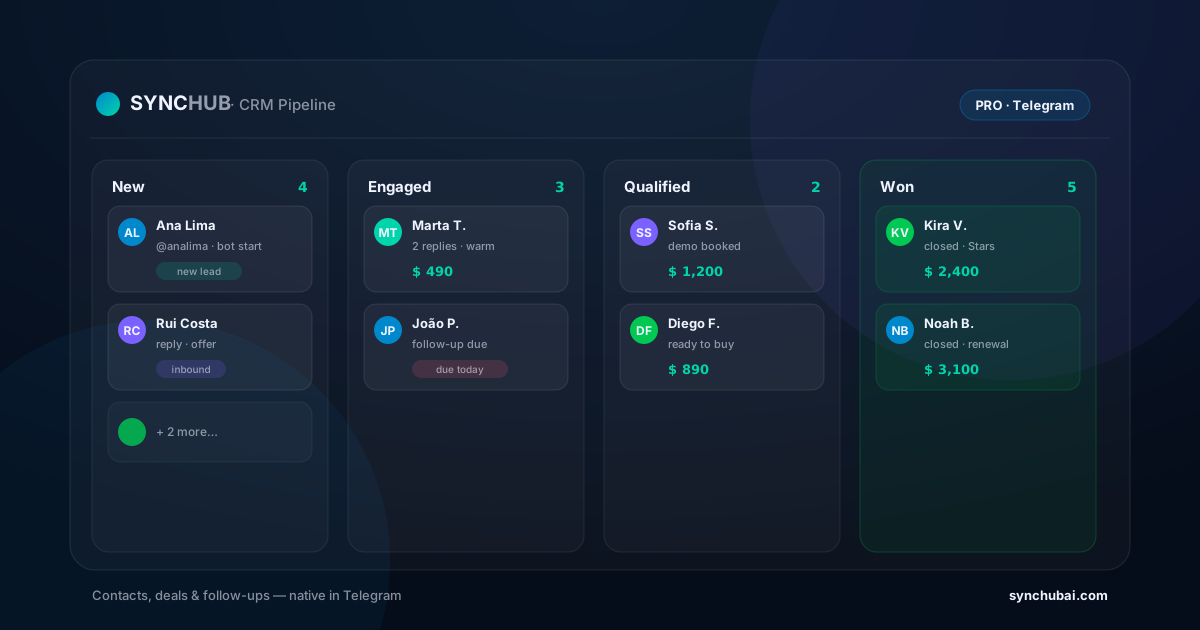
What is a Telegram CRM?
A Telegram CRM is a system that keeps your contacts, deals, lead follow-ups, and pipeline stages attached to the place the conversation already happens — inside Telegram — instead of forcing your team to copy context into a separate app. A traditional CRM assumes the relationship lives in email or a web dashboard. A Telegram CRM assumes it lives in chat, and builds the commercial memory around that reality.
The distinction matters because the cost of a CRM is almost never the software. It's the translation tax: the daily work of moving information from where it happened (the chat) to where it's supposed to be tracked (the tool). A Telegram-native CRM removes most of that tax by keeping both on the same surface.
The real problem is rarely "no CRM." It's scattered context.
Teams that sell, support, or run communities through Telegram usually start simple: chats, pinned messages, forwarded notes, maybe a spreadsheet, maybe a board somewhere else. That works for a while. Then two things happen at once — more conversations arrive, and more people need to touch the same lead.
At that point teams don't lose leads because they lack effort. They lose leads because context is spread across chats, notes, voice messages, spreadsheets, and memory. Nobody is quite sure who last replied, what stage the deal is in, or which follow-up matters today. That's the gap a Telegram CRM is meant to close.
Why I built CRM inside Telegram instead of another dashboard
When we started SYNC Hub, the obvious path was to build "yet another CRM" and connect it to Telegram with an integration. We tried the fragmented version first — and watched operators pay for it every day. One person kept a spreadsheet. Another kept a private note channel. Someone built a Kanban board outside Telegram. The system technically existed, but only because people were manually re-typing information between surfaces.
So we inverted the model. Instead of pulling the conversation into a CRM, we brought the CRM to the conversation. Contacts, deals, pipelines, follow-ups, automation, and AI live on the same operational surface as the chat. The value isn't novelty — it's a lower coordination cost. Fewer handoffs break, fewer leads go silent, and the team trusts one visible source of truth.
What a Telegram CRM solves today
Concretely, a Telegram CRM earns its place by doing four operational jobs well:
- Contacts in one visible place — instead of scattered private notes and forwarded messages.
- Deal tracking without memory — open deals move through pipeline stages instead of living in someone's head or an ad-hoc spreadsheet.
- Lead management and follow-ups — leads are captured at the point of contact and follow-ups are made visible, so nothing disappears silently.
- One shared pipeline view — owners, admins, and operators see the same state at the same time.
This is especially valuable for paid communities, support-heavy products, info businesses, agencies, and small sales operations that already live in Telegram all day.
Telegram CRM for creators: turning followers into customers
Creators are a special case worth calling out, because "audience" and "pipeline" are usually the same people at different stages. A creator running a channel, a paid community, or an info product is constantly converting followers into buyers — but that conversion normally happens in DMs and disappears the moment the chat scrolls up.
A CRM for Telegram creators captures those moments as data: a bot start becomes a lead, a subscriber gets tagged, a buyer moves to a "converted" stage, and follow-ups for people who didn't convert run automatically. You keep the direct, personal feel of Telegram while gaining the memory of a real sales system.
How to choose a Telegram CRM
When you evaluate options, judge them on how much coordination cost they remove — not on feature count. A few practical questions:
- Does it live on the same surface as the chat, or does it make the team switch tools to update anything?
- Can it capture leads at the point of contact (bot start, reply, form) without manual entry?
- Is pipeline state visible to everyone who needs it, or locked in one person's view?
- Does it automate the boring follow-ups, so cadence doesn't depend on someone remembering?
- Does it respect Telegram's model (bots, channels, groups) instead of fighting it with brittle integrations?
If a tool forces your team back into spreadsheets to do real work, it isn't a Telegram CRM — it's a spreadsheet with extra steps.
The limits: when a Telegram CRM is the wrong tool
Honesty helps here. A Telegram CRM is not a universal replacement for large enterprise sales stacks. If you need deep outbound sequencing, complex forecasting, large account hierarchies, or a full BI layer across many channels, a Telegram-first workflow probably shouldn't be your center of gravity.
It's also the wrong answer if your team barely uses Telegram and all meaningful customer interaction already happens elsewhere. The model works best when Telegram is already a real operating surface — not when it's a side channel.
The practical framing
The honest question isn't "should every business have a Telegram CRM?" It's: if your contacts and deals already form around Telegram conversations, how much friction are you accepting by managing the commercial process somewhere else?
When the answer is "too much," the next move isn't more manual glue. It's giving the team one surface where contact context, deal progress, and the next action stay aligned.
Frequently asked questions
What is a Telegram CRM?
A system that manages contacts, deals, lead follow-ups, and pipeline stages inside Telegram, so the commercial workflow stays attached to the chat instead of scattered across separate tools.
What is the best Telegram CRM in 2026?
The best one is whatever lives on the same surface as your conversations and adds the least coordination cost. For teams and creators already in Telegram all day, a native tool like SYNC Hub usually beats bolting a general-purpose CRM on through fragile integrations.
Is there a CRM for Telegram creators?
Yes — creators running paid communities, channels, or info products can capture leads from the bot, tag subscribers, track conversions, and automate follow-ups without exporting anything to another platform.
How does a Telegram CRM handle lead management?
It captures leads at the point of contact, assigns them to a pipeline stage, and makes the next follow-up visible — so it's always clear who last replied, what stage a lead is in, and which follow-up is due today.
Start with the free path and test the workflow on a real use case.
The best first test is simple: open one pipeline, track a few contacts, and see whether your team loses less context over the next week.
Start free in SYNC Hub